Here is the single most useful thing you can know about nicotine cravings: they feel permanent, but they last about three minutes. That gap between perception and reality is where most quit attempts succeed or fail.
When a craving hits, the brain does something clever and cruel — it creates a sense of urgency that makes the feeling seem like it will never end. But the neurochemistry tells a different story.
The Neuroscience of a Craving
A craving begins when a trigger — a sight, smell, situation, or emotion — activates a learned neural pathway in your brain. For smokers, these pathways connect dozens of daily contexts (morning coffee, work stress, social settings) directly to the expectation of a cigarette.
When that expectation fires, your brain releases a pulse of dopamine in anticipation of the reward. This creates the urgent, uncomfortable feeling of wanting. But dopamine release is a wave, not a flood — it rises quickly, peaks, and then the signal naturally decays as the brain awaits the expected outcome.
If you don't smoke, the brain doesn't get its expected confirmation signal, and dopamine subsides within minutes. The craving dissolves on its own. Every time this happens, the neural pathway connecting that trigger to cigarettes becomes fractionally weaker — a process called synaptic pruning.
Research published in the journal Psychopharmacology found that craving intensity peaked at approximately 3 minutes in laboratory conditions and declined significantly by 5 minutes. Distraction was shown to accelerate this decay further.
Why It Feels Longer Than 3 Minutes
Two things conspire to make cravings feel endless:
- Anxiety distorts time perception. When cortisol and adrenaline spike — which they do during a craving — the brain's internal clock slows down. Seconds feel like minutes. This is the same mechanism that makes car accidents feel like slow motion.
- You are focused entirely on the craving. Attention amplifies sensation. When you fixate on how much you want a cigarette, you perceive the craving as more intense and longer-lasting than it actually is.
Both of these effects can be counteracted with deliberate distraction — which is why "just do something else for 5 minutes" is genuinely evidence-based advice, not a platitude.
The Technique: Urge Surfing
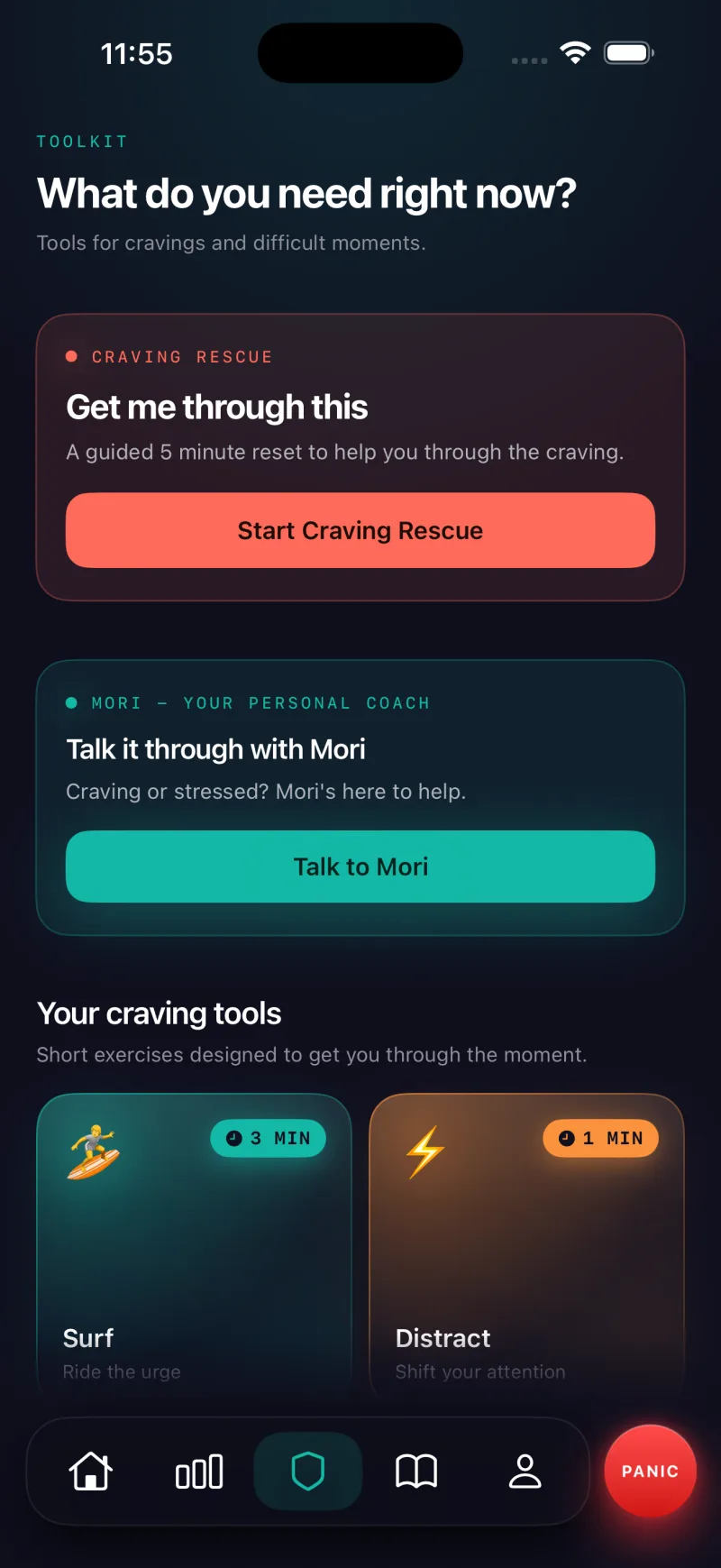
Urge surfing is a mindfulness-based approach developed by psychologist Alan Marlatt. Rather than fighting a craving or immediately giving in, you observe it like a wave — watching it rise, crest, and fall without being swept away.
Here is how to practise it:
- Notice and name it. Say to yourself (or out loud): "I am having a craving. This is a 3-minute wave." Labelling the experience activates the prefrontal cortex, which dampens the emotional intensity of the craving.
- Breathe deliberately. Take four slow breaths — four counts in, four counts out. This reduces cortisol and slows the perceived distortion of time.
- Observe without engaging. Notice where the craving lives in your body. Chest tension? Restless hands? Don't resist it — just watch it. This detachment reduces its grip.
- Wait. The wave will break. It always does.
Practical 3-Minute Interventions
If mindfulness isn't your style, here are evidence-backed alternatives that each take under 5 minutes:
Walk Outside
A change of physical environment breaks the contextual trigger. Even 3 minutes of movement reduces craving intensity by raising endorphins.
Cold Water
Drink a large glass of cold water slowly. It occupies mouth, hands, and attention — all three pathways a craving tries to exploit.
Track It
Open your quit app and log the craving. The act of tracking redirects attention and reinforces your identity as someone actively quitting.
Tactile Distraction
Cravings manifest as restlessness in the hands. Squeezing a stress ball, doing press-ups, or even tapping a rhythm satisfies this physical component.
Cravings Get Weaker With Each One You Outlast
This is the part people don't realise: every craving you ride out without smoking makes future cravings weaker. The neural pathway is not erased, but it is progressively starved of reinforcement. Neurologists call this extinction — the same mechanism that makes phobias fade with repeated non-threatening exposure.
In the first three days, you might face 15–20 significant cravings. By day 7, many people report fewer than 5 per day. By month 1, cravings for most people are rare and brief. The maths are genuinely in your favour.
You are not in a fight you need to win forever. You just need to win the next 3 minutes. Then the 3 minutes after that. Every craving you outlast is a vote for your smoke-free identity — and a physical weakening of the addiction pathways in your brain.
Frequently Asked Questions
What if my cravings last longer than 3 minutes?
Some cravings — particularly in the first 72 hours, or when triggered by alcohol — can feel more prolonged. This is usually because anxiety is stretching your perception of time, or because you are partially engaging with the craving (thinking about smoking) which restimulates the dopamine pulse. True neurochemical cravings still peak within 5 minutes for most people.
Does urge surfing actually work for smoking?
Yes. A 2014 randomised controlled trial found that mindfulness-based smoking cessation (which includes urge surfing) significantly outperformed standard quit attempts at 17-week follow-up. It works particularly well for people who smoke in response to stress or negative emotion.
What if I give in and smoke during the craving?
One cigarette does not erase your progress. Research shows that smokers who resume after a single slip are no more likely to fail their quit attempt than those who don't — provided they return to their quit plan immediately. The most dangerous thing is treating a slip as a failure. It isn't.
This article is general information, not medical advice. Nicotine replacement and stop smoking services can significantly improve your chances of quitting. In the UK, free support is available through the NHS. Speak to your GP or pharmacist about what's right for you.