Most people who quit smoking focus on what they are giving up. But the more useful — and far more motivating — lens is what your body immediately starts recovering. The timeline is more dramatic than most people realise, and it begins within the first 20 minutes of your last cigarette.
What follows is a complete, evidence-based health recovery map from 20 minutes to 15 years. Every milestone here is supported by peer-reviewed research. These are not estimates — they are measured physiological changes.
The milestones below draw from data published by the American Cancer Society, the NHS, and longitudinal studies including the Doll and Peto British Doctors' Study — one of the longest-running smoking and health studies ever conducted.
The Complete Recovery Timeline
Blood pressure and heart rate normalise
Within 20 minutes of your last cigarette, your heart rate begins dropping back to its natural resting rhythm. Blood pressure, elevated by nicotine's vasoconstrictive effect, starts to fall. Circulation to your hands and feet improves as blood vessels begin to dilate.
Carbon monoxide levels halve
Carbon monoxide — the same gas in car exhaust — binds to haemoglobin 200 times more tightly than oxygen, starving your organs. By 8–12 hours, CO levels in your blood have halved. Your blood's oxygen-carrying capacity improves measurably.
Carbon monoxide is fully cleared — heart attack risk drops
All carbon monoxide is eliminated from your bloodstream. Your blood oxygen returns to normal. Critically, your risk of having a heart attack begins to fall from this point. Smokers have roughly twice the heart attack risk of non-smokers; that excess risk starts declining within one day of quitting.
Nerve endings begin to regenerate — taste and smell improve
Nicotine has damaged the nerve endings responsible for taste and smell. At 48 hours, with no further nicotine exposure, these nerve endings begin regenerating. Many ex-smokers report noticing food tastes and smells more vividly within the first few days.
Bronchial tubes relax — breathing becomes easier
The bronchial tubes in your lungs, chronically contracted by nicotine, start to relax. Lung capacity increases. Many people notice they can take deeper breaths by day three. This can also be when the coughing from clearing mucus is most active — a good sign, not a bad one.
Lung function improves by up to 30%
Over the first three months, cilia — the tiny hair-like structures in your airways that sweep out debris — begin to recover. Lung function can improve by up to 30% in this period. Circulation continues improving. Exercise becomes meaningfully easier for most people.
Coughing, shortness of breath, and fatigue reduce
Sinus congestion, fatigue, and shortness of breath reduce significantly. The lungs are more effective at filtering infection. Many ex-smokers report their first year smoke-free involves notably fewer respiratory infections and colds than they experienced while smoking.
Heart disease risk is halved
At the one-year mark, your excess risk of coronary heart disease is approximately half that of a current smoker. This is a dramatic reduction in just twelve months. Your blood is less sticky, arteries are less inflamed, and your heart is under significantly less strain.
Stroke risk equals a non-smoker's
After five years smoke-free, your risk of stroke has fallen to the same level as someone who has never smoked. This applies to all types of stroke — ischaemic and haemorrhagic. The arterial damage from smoking is largely reversed.
Lung cancer risk is halved
Lung cancer risk is now approximately 50% of that of a continuing smoker. The risk of cancers of the mouth, throat, oesophagus, bladder, kidney, and pancreas all decline significantly. Pre-cancerous cells in the lungs have been replaced by healthy cells.
Heart disease risk equals a lifelong non-smoker's
At the 15-year mark, your risk of heart disease is the same as someone who has never smoked. The body's capacity for recovery — even after decades of smoking — is extraordinary. It is never too late to quit.
Risk Reduction at a Glance
Is It Too Late to Quit?
No. The data on this is remarkably consistent. People who quit at 60 gain, on average, three additional years of life. People who quit at 50 gain six years. People who quit at 40 gain nine years. People who quit before 35 have a life expectancy nearly identical to those who never smoked.
Even partial recovery is significant. Quitting at 65, after 45 years of smoking, still meaningfully reduces your risk of a cardiac event in the next decade. The biological mechanisms of recovery do not have a cutoff age.
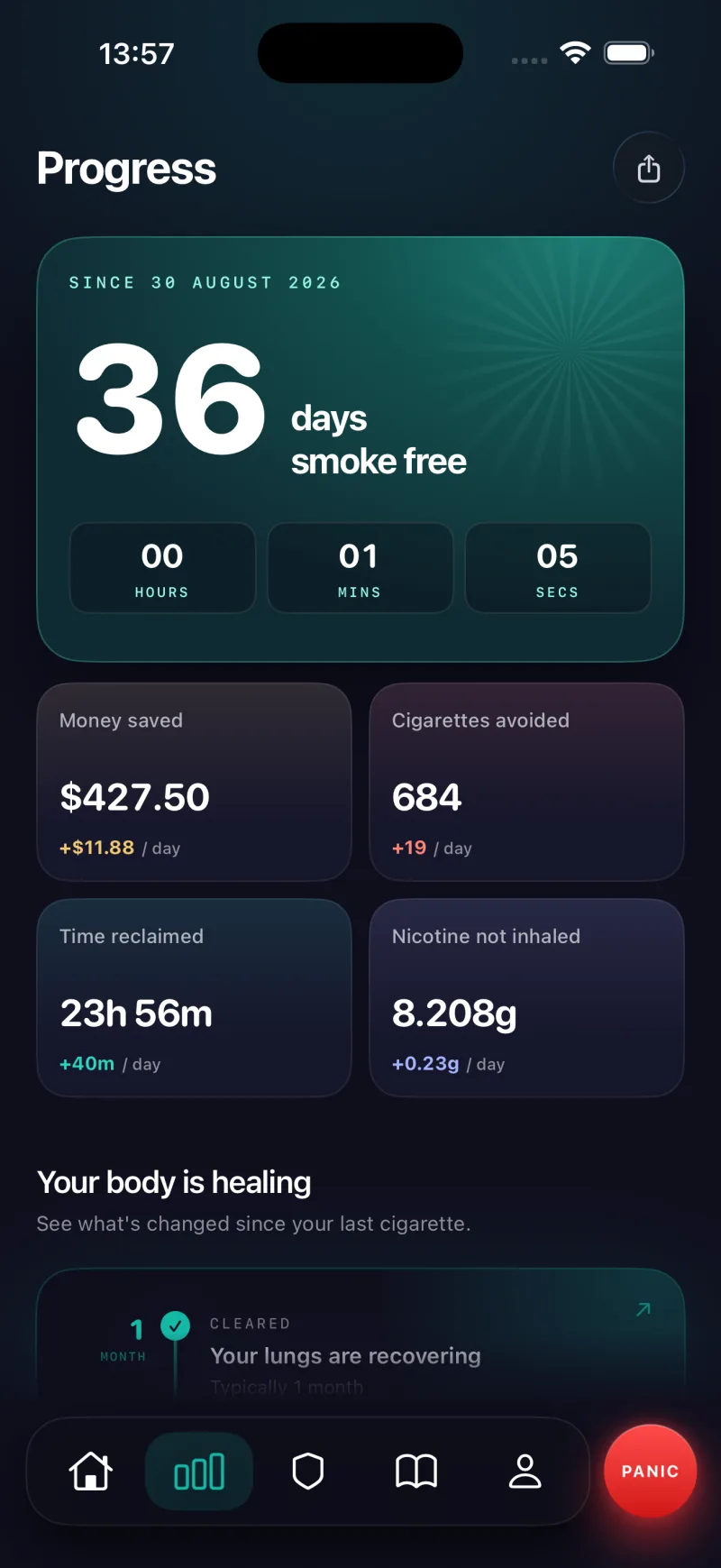
Within 20 minutes of your last cigarette, your body is already working to repair itself. You don't have to do anything except not smoke. The healing begins immediately and continues for fifteen years. Every smoke-free minute counts.
Frequently Asked Questions
Do your lungs fully recover after quitting smoking?
Not entirely — some structural damage, particularly in people with established COPD or emphysema, is permanent. However, lung function improves significantly for most ex-smokers, and the progression of lung disease slows dramatically after quitting. The cilia and mucus-clearing mechanisms recover substantially within months.
How long until ex-smokers have the same heart disease risk as non-smokers?
Approximately 15 years, according to data from the British Doctors' Study and the American Cancer Society. The excess risk halves within one year, continues declining, and reaches equivalence around the 15-year mark.
Does the health recovery timeline differ by how long or how heavily you smoked?
Yes — heavier and longer-term smokers generally start from a lower baseline and may take longer to reach non-smoker risk levels. However, the trajectory of improvement is the same for all quitters, and the benefits are clinically meaningful at every stage regardless of smoking history.
This article is general information, not medical advice. Nicotine replacement and stop smoking services can significantly improve your chances of quitting. In the UK, free support is available through the NHS. Speak to your GP or pharmacist about what's right for you.